A local concierge chat
Scope a visitor concierge for independent hospitality businesses.
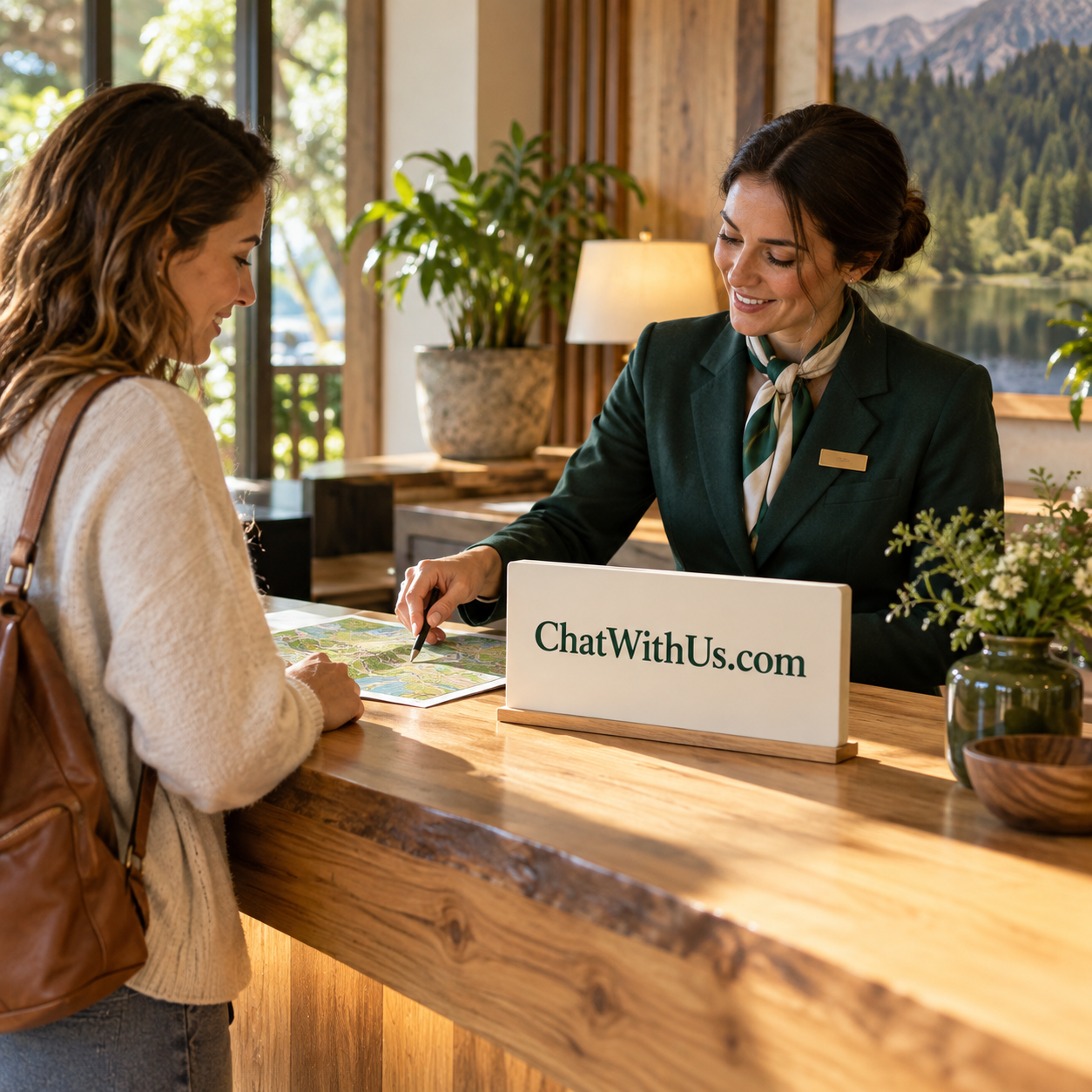
A guest arriving in an unfamiliar neighborhood often has a practical question that falls between a booking confirmation and a full concierge appointment. They may want to understand the arrival instructions, find an appropriate local option, or ask who can help with a change of plan. An independent property may have the answer but lack a dedicated person to keep that conversation moving throughout the day.
This is an illustrative business concept for ChatWithUs.com. A local concierge operator could provide a defined conversation service for a small group of independent hospitality properties. The properties would be the commercial customers. Their guests would use the service for a clear set of requests, with the operator passing property decisions to the people authorized to make them.
Choose a small service area
The first version should cover a place the operator can maintain accurately. A neighborhood or compact town is easier to research and update than an entire region. Local knowledge has a maintenance cost: opening hours change, a supplier may stop offering a service, and a property may revise its arrival arrangements. The operator needs a way to notice and record those changes.
The opening offer might include arrival questions, explanations of property information, and suggestions drawn from an agreed local directory. It should define the staffed hours and explain what happens outside them. Emergency requests need a clear route to the appropriate local or property contact rather than being left in an ordinary conversation queue. The service should never imply continuous emergency coverage merely because a message box is available.
ChatWithUs.com could appear on a guest welcome card or in a property's pre-arrival message. The destination page would identify the property and the service's scope before a guest starts a request. That context matters because a guest should understand whether they are speaking to property staff, an outside concierge operator, or a local supplier.
Build a property-specific reference
Each property needs its own reference pack. Begin with approved arrival instructions, the contact for operational questions, and the requests the concierge can handle directly. Mark information that must be checked with staff. A public recommendation about a nearby cafe is a different responsibility from approving a late checkout or changing a guest's booking.
Give every operational instruction an owner and a review date. If a property sends a change by message, update the reference rather than leaving the new detail in one agent's personal inbox. Staff covering the next shift should see the same information. A short change log can explain what changed and whether guests already in conversation need an update.
The GOV.UK guide to learning user needs is useful when planning the initial interviews. Ask property managers about recent guest requests and how they were handled. A list of actual recurring questions will give the operator a stronger starting point than a broad assumption that travelers want a chat service.
Follow one request from start to finish
Imagine a guest asking whether a bag can be stored before check-in. The concierge checks the property's approved information and finds that staff confirmation is required for that day. The agent records the request, sends it to the named property contact, and tells the guest that confirmation is pending. The agent does not turn an unconfirmed possibility into a promise.
When staff reply, the concierge passes on the answer and records that the guest received it. If the shift ends first, the request moves to a named person with a clear summary of what is still needed. The important record is not simply that a message was sent. It is whether somebody owns the outstanding action and can explain the current state to the guest.
A ticketing system may help organize those handoffs. Zendesk's ticket overview describes assignment and internal notes as separate parts of a support record. A concierge operator can evaluate comparable features in its chosen tools while designing a process that property staff will actually use.
Keep local recommendations useful
A local directory should record what a supplier offers, how the information was checked, and any conditions that affect the recommendation. Avoid presenting an old note as a current guarantee. If a guest has a requirement that needs confirmation, the service should say so and direct the question to somebody who can answer it.
If suppliers pay for placement or referrals, the operator needs a clear commercial policy and appropriate disclosure. The first pilot can avoid that complexity by focusing on property-paid assistance and a small, maintained information set. The purpose of the pilot is to understand the work and the guest experience, not to add every possible revenue stream at once.
Find the first property partner
A useful distribution path is a direct conversation with one independent property manager. Bring a draft list of supported questions and ask where it matches their actual workload. Show the manager an example handoff and a proposed shift report. Their objections may reveal the most important design requirements, such as how quickly a staff member can be reached or which requests must stay entirely with the property.
Plan the pilot around a manageable period and a limited group of guests. Track the types of requests received, the time spent researching them, and how often staff decisions are needed. Review any unanswered or incorrectly routed request before expanding coverage. Low volume is still informative if it shows that guests prefer an existing channel or that the invitation appears too late in their journey.
The next step is to map ten common questions with one property manager and classify who can answer each one. That map can become the basis of a bounded pilot. A buyer considering ChatWithUs.com for this model can inquire about acquiring the domain and outline the intended service area and property audience.